
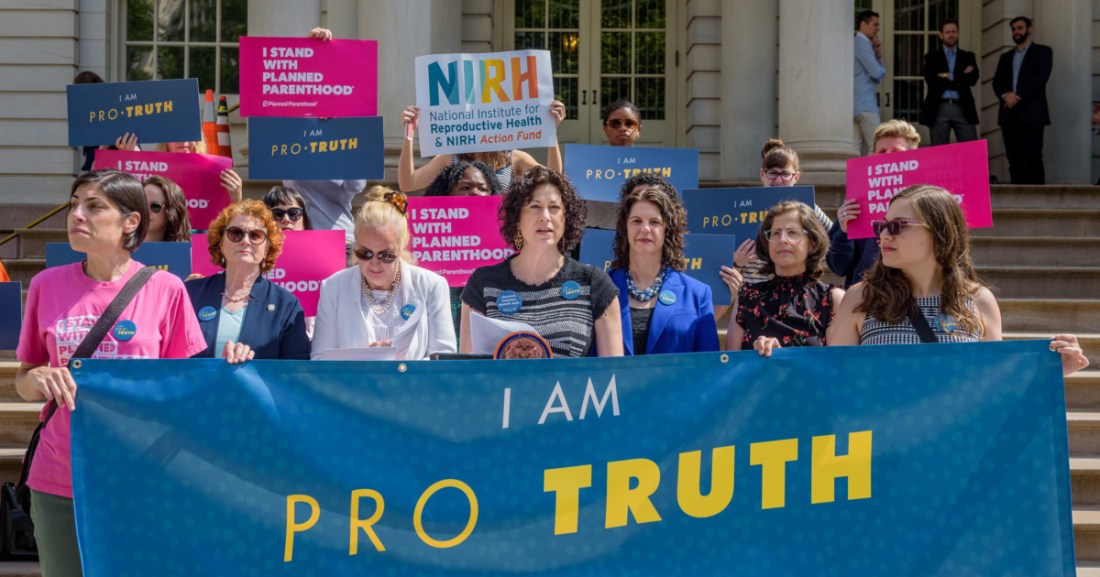
What just happened?
I know there is a lot of commentary going around about this bill, but what I haven’t seen is an easy way for us to read this bill ourselves. It’s actually a lot shorter than you might expect!
If you’re among the many out there talking about this bill, give yourself the added benefit of saying you’ve done more than read a review of the bill from a pro-life or pro-choice website. Bolster your argument by reading the bill itself! Once you do, I suspect that even those of you who profess to be generally pro-choice will see very concerning issues with this bill. You’re not compromising your support to protect women’s lives by voicing your opposition to what just happened, as you’ll hopefully see below.
Throughout the language of the bill, which I’ve formatted to be easier for reading, you’ll find some of my own observations and explanations in [brackets and italics, like this].
Here we go…
Introduced by Sens. KRUEGER, STEWART-COUSINS, BRESLIN, COMRIE, DILAN, GIANARIS, HOYLMAN, KAMINSKY, LATIMER, MONTGOMERY, PARKER, PERALTA, PERSAUD, RIVERA, SERRANO, SQUADRON, STAVISKY [That’s 17 Senators in case you weren’t counting.]
AN ACT to amend the public health law, in relation to enacting the reproductive health act and revising existing provisions of law regarding abortion; to amend the penal law, the criminal procedure law, the county law and the judiciary law, in relation to abortion; to repeal certain provisions of the public health law relating to abortion; to repeal certain provisions of the education law relating to the sale of contraceptives; and to repeal certain provisions of the penal law relating to abortion.
THE PEOPLE OF THE STATE OF NEW YORK, REPRESENTED IN SENATE AND ASSEMBLY, DO ENACT AS FOLLOWS: [Very interesting to note how these lawmakers claim that it’s the people of New York who are enacting this bill while every poll I’ve seen regarding public opinion on abortion has shown the majority of people– even those who would generally identify as pro-choice, are directly opposed to the measures included here. More on that later.]
Section 1. Legislative intent. The legislature finds that comprehensive reproductive health care, including contraception and abortion, is a fundamental component of a woman’s health, privacy and equality. [This language stems all the way back to the arguments given during Roe v. Wade hearings, where proponents of abortion argued that since men have the freedom to not be pregnant, women must have that freedom as well.] The New York Constitution and United States Constitution protect a woman’s fundamental right to access safe, legal abortion, courts have repeatedly affirmed this right and further emphasized that states may not place undue burdens on women seeking to access such right. [What that also apparently means is that states should let the complete indoctrination of its women and kids to make them believe pregnancy is an only an optional result of sex, which only confirms and furthers the problem of unwanted pregnancies in the first place.] Moreover, the legislature finds, as with other medical procedures, the safety of abortion is furthered by evidence-based practices developed and supported by medical professionals; any regulation of medical care must have a legitimate purpose. [This regulation must also be supported from the secular, humanist worldview. To be expected, of course, from a democratic process where “humans rule” (the literal meaning of democracy). But it’s just important to note here.] Abortion is one of the safest medical procedures performed in the United States; the goal of medical regulation should be to improve the quality and availability of health care services.
Furthermore, the legislature declares that it is the public policy of New York State that every individual possesses a fundamental right of privacy and equality with respect to their personal reproductive decisions
and should be able to safely effectuate those decisions, including by seeking and obtaining abortion care, free from discrimination in the provision of health care.
Therefore, it is the intent of the legislature to prevent the enforcement of laws or regulations that are not in furtherance of a legitimate state interest in protecting a woman’s health that burden abortion access.
Section 2. The public health law is amended [changed] by adding a new article 25-A to read as follows:
ARTICLE 25-A
REPRODUCTIVE HEALTH ACT
SECTION 2599-AA. ABORTION.
1. A HEALTH CARE PRACTITIONER LICENSED, CERTIFIED, OR AUTHORIZED UNDER TITLE EIGHT OF THE EDUCATION LAW, ACTING WITHIN HIS OR HER LAWFUL SCOPE OF PRACTICE, MAY PERFORM AN ABORTION WHEN, ACCORDING TO THE PRACTITIONER’S REASONABLE AND GOOD FAITH PROFESSIONAL JUDGMENT BASED ON THE FACTS OF THE PATIENT’S CASE: THE PATIENT IS WITHIN TWENTY-FOUR WEEKS FROM THE COMMENCEMENT OF PREGNANCY, OR THERE IS AN ABSENCE OF FETAL VIABILITY, OR THE ABORTION IS NECESSARY TO PROTECT THE PATIENT’S LIFE OR HEALTH.
[There’s obviously quite a few implications in this paragraph. First, it’s important to note that “an absence of fetal viability” as a permissible reason for abortion is separated from how many weeks along that fetus is. The way this is written, a mother whose fetus has been developing for 23 weeks and five days in her womb could choose to have an abortion for any reason she chooses. That brings the next point: the number of weeks a fetus has in the womb is also separated from the final permissible reason for abortion, which is “to protect the patient’s life or health.” If a woman’s baby is 24-32 weeks, all that mother needs to come up with is a health-related reason to have her baby done away with. With such a seemingly-deliberate use of the word “health” without any kind of definition attached to it, health here could include literally anything. The mother lost her job so she is not financially healthy enough to have her baby. The mother’s boyfriend left and so now she’s emotionally and financially unhealthy. Never mind that a baby this far along is viable outside the womb and can just as easily be birthed into an adoptive placement that would also cover all of her medical bills. By the way, the method used to terminate a pregnancy in the third trimester is essentially by lethal injection, which we know from its use in carrying out capital punishment. Capital punishment was ruled to be unconstitutional in New York, making it deadlier to be in your mother’s womb than in prison.
[This section also specifies that non-doctors are now legally able to conduct abortions in New York, something which undermines the argument that the pro-choice movement is all about a woman’s safety. What this means is that more health professionals, or so-called, will be able to perform abortions, meaning instead of every woman having to line up in front of the handful of doctors offering abortions, there are now exponentially more lines available. It’s like being at Wal-mart and having that all-too-familiar frustration that they don’t have more check-out lines open. What happens when they bring up more check-out attendants? The lines disappear almost immediately while more customers are served.]
2. THIS ARTICLE SHALL BE CONSTRUED AND APPLIED CONSISTENT WITH AND SUBJECT TO APPLICABLE LAWS AND APPLICABLE AND AUTHORIZED REGULATIONS GOVERNING HEALTH CARE PROCEDURES.
Section 3. Section 4164 of the public health law is REPEALED. [Thrown away]
Section 4. Subdivision 8 of section 6811 of the education law is REPEALED.
Section 5. Sections 125.40, 125.45, 125.50, 125.55 and 125.60 of the penal law are REPEALED, and the article heading of article 125 of the penal law is amended to read as follows: HOMICIDE[, ABORTION] AND RELATED OFFENSES
Section 6. Section 125.00 of the penal law is amended to read as follows:
§ 125.00 Homicide defined. Homicide means conduct which causes the death of a person [or an unborn child with which a female has been pregnant for more than twenty-four weeks] under circumstances constituting murder, manslaughter in the first degree, manslaughter in the second degree, OR criminally negligent homicide[, abortion in the first degree or self-abortion in the first degree].
[This confirms that abortion not performed in the extremely vague outline of this new bill is still considered a criminal offense. Since the state has just likely doubled or tripled the number of places she can go to receive an abortion now that a doctor is not required, and also allowed any health-related reason as permissible justification for an abortion at any time, the situations where a woman could actually be charged and convicted would be if a woman decides to give herself an abortion or to have someone who watched a YouTube video on how to perform abortions try to do it. Going to a medical provider will give her 100 percent protection to terminate her pregnancy at any time and for any reason from the moment she is pregnant until the day she is face to face with the life being miraculously developed inside of her.]
Section 7. The section heading, opening paragraph and subdivision 1 of section 125.05 of the penal law are amended to read as follows: Homicide[, abortion] and related offenses; [definitions of terms] DEFINITION. The following definition is applicable to this article:
[1.] “Person,” when referring to the victim of a homicide, means a human being who has been born and is alive.
[It’s horrifying and disturbing that the only two words in this bill which New York lawmakers thought were ambiguous enough to need specific definitions were “homicide” (above in Section 6) and “person”. Again, it was apparently unnecessary to define “health”. What’s so maddeningly inconsistent, though, is that any prenatal surgeon you might talk to will consider both mother and baby as its patients, and offer both of them their own anesthesia. Patients are the focus of every doctor’s Hippocratic Oath, which specifically prohibits abortions, and goes further to commit to doing no intentional harm to anyone. Now, I suppose the only thing that determines whether an unborn baby gets anesthesia or a lethal injection is whether that baby is wanted by its mother or not.
Section 7-a. Subdivisions 2 and 3 of section 125.05 of the penal law are REPEALED.
Section 8. Subdivision 2 of section 125.15 of the penal law is REPEALED.
Section 9. Subdivision 3 of section 125.20 of the penal law is REPEALED.
[Essentially what was done with repealing these subdivisions of previous laws was to make the state laws of New York at least match what was decided by the Supreme Court in Roe v. Wade in 1973. The state laws being repealed here were originally written before Roe, and were basically nullified by the Supreme Court decision because all state laws are superseded by federal laws. What New York basically did here was to ensure that even if Roe v. Wade were somehow repealed, they would still have a version of it (a more advanced version, actually) in their own state code. These previous laws, now repealed, limited a woman’s access to abortion only to matters of a woman’s life. Now, matters of a woman’s health have been added to reasons to obtain a lawful abortion, just like Roe v. Wade did. No laws I’ve found anywhere, even in Roe, define which areas of a woman’s health are included and which are not, leaving all areas of health– emotional, physical, financial, or even relational– on the table as a justifiable excuse to have an abortion. For Roe, the limit for this health-related allowance was when the fetus was considered viable. With this new law, however, New York just upped this allowance up to the moment a baby is birthed from the mother’s womb. It literally takes Roe v. Wade to its absolute furthest point before it breaks under the federal precedent, taking advantage of every vague reference from 1973. Sounds like a future Supreme Court in the making. If that happens, New York will have paved the road leading straight to the place it claimed it was protecting itself from. Also, interesting fun fact: Norma McCorvey, the plaintiff who filed Roe v. Wade under the pseudonym “Jane Roe”, publicly declared her opposition to abortion later in life.
[It’s massively important to note here that access to legal abortions in the event of a woman’s life being at risk were already protected by federal laws before this bill was passed. What’s really confusing is why “the people of New York” (aka 17 senators) felt this was not sufficiently protecting women’s lives and needed to add any health-related fear or circumstance at any stage of pregnancy to protected reasons for abortion. Previously, the pro-choice movement has built its entire argument on two basic principles: 1. protecting women’s lives and, 2. the value of unborn life begins at viability. This bill goes illogically beyond these two principles to the point where the pro-choice movement has just revealed that it has no clue what it’s doing and that it has officially undone every moral argument it previously stood on. With no remaining scientific or safety or life-saving arguments to use as a fail-safe in moral debates around abortion, all that’s left for them to say is that feelings matter more than human lives. That’s also quite possibly the slipperiest slope our nation has ever given itself and we may want to buckle up for the coming implications of such a view in practice. Germany had a rough go of it from what I hear.
[Also interesting to note is an abortion during the third trimester of a pregnancy involves the same basic practice as a normal birth at full-term. This means an abortion at this stage would be performed simply to not have to wait just a little while longer to do the exact same thing, only this time, the baby is being given a chance to live.]
Section 10. Paragraph (b) of subdivision 8 of section 700.05 of the criminal procedure law, as amended by chapter 368 of the laws of 2015, is amended to read as follows:
(b) Any of the following felonies: …
[I’m saving a lot of space here. This section proceeds to list the 86… yes, I counted… laws that still allow a person to be charged in criminal court. Almost half of the bill’s 4.5 pages are comprised of this list, the reason for which is seemingly to remove abortion from it. Still remaining on the list of criminal charges in New York are anything from “falsifying business records”, first/second/third degree “criminal mischief” and “trademark counterfeiting” to “negligent homicide”, first/second degree “manslaughter”, and “promoting a suicide attempt”. Based on Section 6 of this bill, abortion is still included as a criminal offense under “homicide”, but only if the unborn baby has been in the womb for more than 24 weeks. Effectually, this means that an abusive boyfriend or a drunk driver who indirectly causes the death of a 22-week old unborn baby will not be charged with manslaughter or murder, even though unborn babies reach the point where they could be kept alive outside the womb somewhere around 20 weeks.]
Section 11. Subdivision 1 of section 673 of the county law, as added by chapter 545 of the laws of 1965, is amended to read as follows:
1. A coroner or medical examiner has jurisdiction and authority to investigate the death of every person dying within his county, or whose body is found within the county, which is or appears to be:
(a) A violent death, whether by criminal violence, suicide or casualty;
(b) A death caused by unlawful act or criminal neglect;
(c) A death occurring in a suspicious, unusual or unexplained manner;
(d) [A death caused by suspected criminal abortion;
(e)] A death while unattended by a physician, so far as can be discovered, or where no physician able to certify the cause of death a provided in the public health law and in form as prescribed by the commissioner of health can be found;
[(f)] (E) A death of a person confined in a public institution other than a hospital, infirmary or nursing home.
[I tried finding what this section previously said but apparently they took seriously Section 13 below to enact this bill immediately because all I can find is this exact language in the county law. If anyone knows what this section previously said or how it’s been changed, I’m interested to hear!]
Section 12. Section 4 of the judiciary law, as amended by chapter 264 of the
laws of 2003, is amended to read as follows:
§ 4. Sittings of courts to be public. The sittings of every court within this state shall be public, and every citizen may freely attend the same, except that in all proceedings and trials in cases for divorce, seduction, [abortion,] rape, assault with intent to commit rape, criminal sexual act, bastardy or filiation, the court may, in its discretion, exclude therefrom all persons who are not directly interested therein, excepting jurors, witnesses, and officers of the court.
Section 13. This act shall take effect immediately.
[Jesus, this whole thing is going to hell in a hand basket. Please come back.]
 nikaō.life