Weird word, right?
I had personally never heard of it before, either. That is, until I was going through the book of Revelation back in 2017. It was unlike my other readings of the book because this time, I had come to deeply appreciate some of the interlinear resources out there like Blue Letter Bible or Bible Hub. With these, you can actually look up what the original Hebrew and Greek words of a scripture were before they were translated into English. I don’t want to get too nerdy on you, but it’s just helpful to see original context and discover some deeper patterns that can only be found under the surface of English translations.
As I read through Revelation, I kept noticing this one phrase in each of Jesus’ letters to the churches: “The one who conquers…”
“To the one who conquers I will grant to eat of the tree of life, which is in the paradise of God.” (Rev. 2:7)
“The one who conquers will not be hurt by the second death.” (Rev. 2:11)
“To the one who conquers I will give some of the hidden manna, and I will give him a white stone, with a new name written on the stone that no one knows except the one who receives it.” (Rev. 2:17)
“The one who conquers and who keeps my works until the end, to him I will give authority over the nations, and he will rule them with a rod of iron, as when earthen pots are broken in pieces, even as I myself have received authority from my Father. And I will give him the morning star.” (Rev. 2:26-28)
“The one who conquers will be clothed thus in white garments, and I will never blot his name out of the book of life. I will confess his name before my Father and before his angels.” (Rev. 3:5)
“To the one who conquers I will make him a pillar in the temple of my God. Never shall he go out of it, and I will write on him the name of my God, and the name of the city of my God, the new Jerusalem, which comes down from my God out of heaven, and my own new name.” (Rev. 3:12)
These are just six of the 15 total references in the book of Revelation alone. As I read, I naturally wondered about the Greek root of this phrase and what else it had been used for. Within minutes, I was blown away with how powerful this really was.
Nikaō:
- to conquer
- to carry off the victory, come off victorious
- of Christ, victorious over all His foes
- of Christians that hold fast their faith even unto death against the power of their foes, and temptations and persecutions
- when one is arraigned or goes to law, to win the case, maintain one’s cause
This is the same word Jesus used to encourage His disciples in John 16:33, “I have said these things to you, that in me you may have peace. In the world you will have tribulation. But take heart; I have overcome the world.”
It’s the same word Paul used in Romans 21:12 when he wrote, “Do not be overcome by evil, but overcome evil with good.”
To be called nikaō is to be a conqueror. Fittingly, the word nikaō actually inspired one of the most recognizable brands in the world: Nike. But in the Christian worldview, being the victor isn’t always the one breaking records or standing on the platform holding the trophy. The Christian victory from the world’s perspective is actually more often marked by rejection, misunderstanding, and ridicule. And yet, the Christian is encouraged in receiving this response from the world.
Jesus was the conqueror we measure our own success by. He is the one who, before being executed for the disruption He brought to the worldly system, said, “If the world hates you, keep in mind that it hated me first. If you belonged to the world, it would love you as its own. As it is, you do not belong to the world, but I have chosen you out of the world. That is why the world hates you. Remember what I told you: ‘A servant is not greater than his master.’ If they persecuted me, they will persecute you also. If they obeyed my teaching, they will obey yours also. They will treat you this way because of my name, for they do not know the one who sent me.” (John 15:18-21)
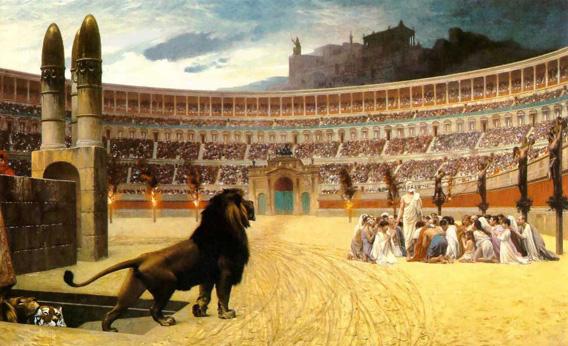
By this standard, Stephen was victorious when he was stoned to death. So was Paul when he was beheaded; and Peter when he was crucified upside down. All of the martyrs of the faith in the first century, and since, are victors. These leaders were killed for their faith, but they held onto it as the most precious thing they’d been given all the way to their deaths. And the only way they could’ve done it is if they already counted themselves as victors because of their hope in what Christ had accomplished.
To live a nikaō life means to be focused on the eternal reality of what we’ve been promised and how we’ve been taught. It means being engaged in the world not to find acceptance from the world but to embrace our responsibility as an ambassador of Christ– to root out sin in our own lives and pursue radical Biblical community. To love our neighbor sacrificially, not for the sake of elevating man and prizing only his comfort but to illustrate how God descended to us and gave us a hope that isn’t based on our circumstances. To carry a message of adoption into the kingdom of God, which the world still actively rebels against, all the while ready to see the backlash we’ve been promised.
The reaction by a conqueror after being ignored, threatened or abused is not to hide away and build walls of isolation and fear. Our reaction is to celebrate that we’ve been counted worthy to receive the same treatment as our Master, and to press in with even more joy.
When Peter and the other apostles who were taken prisoner by the Sanhedrin were eventually beaten and let go, Acts 5 tells us they did not stop going from house to house sharing the news of what Jesus had just done. I picture these conquerors, fresh wounds on their bodies and faces from the lashing and abuse they’d just been given, limping a little as they made their way along the streets of Jerusalem to find another way to fit Jesus into their conversations. I imagine being a resident of Jerusalem and opening my front door to see someone with a black eye and bloodied lip smiling at me as they asked me if I’d heard how God had finally provided us with His promised Lamb. That I’m no longer enslaved by the Law, which challenges me earn my righteousness. That I’ve been set free to pursue Christ and let Him transform my heart and my identity from the inside out so that it is no longer myself I serve but rather Him who justified me.
God willing, and with all of the accountability He can send us, we can live the nikaō life, too.
 nikaō.life