
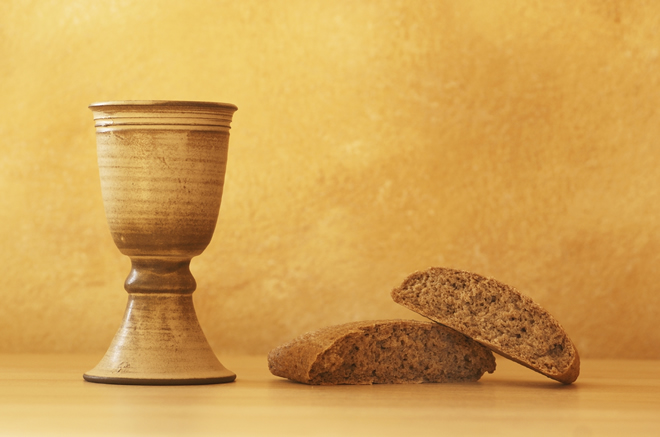
Anyone who grew up in the church recognizes the ritual. You may know it as The Lord’s Supper– maybe the Eucharist if you’re the formal type. I suppose it really doesn’t matter what you call it, as long as you know it as one of the major Christian sacraments.
But do we really understand what it means? For years, the only answer I could give was that it was an imitation of a rather awkward encounter in the upper room between Jesus and His disciples. Jesus said to keep doing it as a way to remember Him and what He did for us–and so we do. End of story.
This explanation seems sufficient to most of us, I think. And that’s okay and even good. There’s plenty of meaning behind a meal that is meant to remind us that Christ died for our sins.
For so long, I imagined this first Communion and pictured the disciples looking around at each other in confusion, quietly wondering, “What’s this new ritual we’re doing?” After all, Jesus did have a way of teaching in relatively abstract ways and, at the time, the cross that would make sense of this “new” ritual was still a day away. But still, I had a feeling there was more of an immediate meaning to this meal for the disciples, especially since I’ve already seen some of the ways that understanding ancient Hebrew culture changes the context of Biblical history for an American Christian like me.
Jesus lived the perfect life none of us can live, but we can’t forget that Jesus’ perfection was rooted in Jewish culture, which had been around for thousands of years already. We limit our understanding of both God and the Church when we think of Jesus and His disciples as “the first Christians” instead of devoted Jews. And because of this, it’s critical that we understand the Jewish cultural lens. Otherwise, we will often miss the true significance of something when we label it only as Christian.
With that in mind, here are two really amazing truths about the “first Communion.”
- It was an engagement ceremony
We’ve lost this context because marriages look so much different today than they did back then, but the disciples would have likely recognized this very clearly. This really shouldn’t come as much of a shock, right? All throughout the gospels and the New Testament, the Church is constantly referred to as the bride of Christ. But not many believers today understand that Communion is meant, in part, to be the celebratory feast commemorating this relationship.Let me explain by laying out what a traditional marriage would have looked like in ancient Israel. Then, we will look at how Jesus’ purpose and actions fit this marriage model perfectly.
First, a Jewish man would travel, sometimes great distances, in search of a bride. When he found her, he would make an agreement with the woman’s father, and with his approval, the engagement would be announced. A banquet would be held at the bride’s house in celebration of the impending marriage, and at this banquet, the groom and his future bride would drink from the same cup of wine to symbolize their commitment to each other.
After the feast, now officially engaged, the groom would travel back to his home country and begin to prepare a place for his bride. Most of the time, this place would be near or even attached to his father’s house, since families operated as multi-generational units back then.
All this time, the bride-to-be would patiently wait for her groom to return. It would sometimes take a year or more, and the groom would only return to receive his bride once the place he was preparing for her was completed. The time of his return would be at an unsuspecting hour to the bride, but the expectation for her was to stay committed and pure, ready to give herself to her husband whenever he made his way back for her. This arrival would be a huge celebration. Many times, the groom’s men would accompany the groom with trumpets and songs in a procession along the way, especially as they were getting close to the bride’s hometown. When they arrived to the bride’s home, another feast (or banquet) would ensue, which the whole town would often be invited to.
Do you see the amazing similarities here? Jesus was sent from heaven for the purpose of bringing His chosen people back into a restored relationship with God (Mark 10:45). He consistently referred to this desired relationship as a marriage (Mark 2:19-20).
On the night of the first Communion, Jesus and His disciples enjoyed a ceremonial feast together, even drinking wine from the same cup just like an engaged couple would do. Jesus had openly and repeatedly acknowledged that He would be leaving His disciples (the church) and travel back to where He came from. The very next day, Jesus was killed on the cross, which began the process of Him returning to heaven with His Father where He promised to prepare a place for His followers and come back to bring us to where He is (John 14:3). He warned that the day and time of His return would remain unknown, and that we should keep ourselves ready (Matthew 25:1-13).
The disciples would have recognized the similarities of this event to an engagement celebration. They were entering a covenant of commitment and purity with their Lord, and each time afterwards would be, in a sense, a renewing of this vow of commitment. It was a constant reminder to stay ready and expectant for Jesus to return and bring His bride into its full glory.
- It was instructions for for the final Passover
The second cultural aspect of the first Communion we’ve lost touch with is the fact that Jesus and His disciples were gathering to celebrate the Passover. This was (and still is) one of the most important holidays of the year for Jews. Flashing back to Exodus 12, families and friends would gather to celebrate the time when God’s judgment literally “passed over” the house of the enslaved Israelites while killing the first born of every other family in Egypt. The morning after, with chaos and mourning everywhere, the Pharaoh finally decided he had enough and set the Jews free from captivity. This moment in Israel’s history is what opened the door to the foundations of the first Jerusalem, and the establishment of the first established nation and home for God’s people.
Here’s where the perfection of Jesus celebrating the Passover with His disciples really starts to become clear. The saving grace that distinguished the Jewish households from the others during the original Passover in Egypt was blood from a sacrificed lamb that had been spread across their front door frames.
During that first Communion, Jesus sat down for the Passover celebration with His disciples and explained to them that He was about to be betrayed and killed. He made it clear that His sacrifice would offer atonement for our sins at the end of the world—in a sense, the final Passover. The same way the captive Jews in Egypt publicly painted the lamb’s blood over their front door frames in faith that it would save them from God’s judgement over Egypt, Jesus instructed His followers to publicly paint their lives with evidence of their faith that His blood would save them from God’s judgement at the end of the world.
Isaiah, a prophet who lived roughly 700 years before Jesus was born, had already written about this. He prophesied about the Messiah and said that He would be like a sheep led to the slaughter (Isaiah 53). John the Baptist called Jesus the “Lamb of God” before anyone knew that He was the Messiah they had been waiting for (John 1:36).
We worship Jesus partly out of awe that He rose from the dead, and that’s important. But the most important fact is that He was killed. The book of Revelation attests to this, as we see over and over Jesus being worshiped as the one who was slain, not the one who was raised. His blood is the reason our sins are forgiven—the reason that God’s judgment will “pass over” our sins at the resurrection. His blood is the reason we’ve been given to celebrate a restored relationship with our Creator, and it’s the event that will open the door to the New Jerusalem that God has promised to establish for His people. It might not even be too far of a stretch to compare this time in between as another instance of wandering in the wilderness.
For the disciples, the first Communion started as another Passover celebration. As Jews, they had likely done this every year of their lives. But this time, Jesus took time to explain that the Passover feasts of the future would have a second Lamb to celebrate—Himself.
And there we have it. I’m fascinated by this and hope some of you think of it next time you’re taking Communion in church. Ultimately, we are doing more than just remembering. We are also renewing our vow of commitment, purity, and readiness for our Lord to come back for His bride, the church. And we are celebrating that God has given us the blood that justifies us and will free us from the captivity of this world. He will lead us to a New Jerusalem!
 nikaō.life